Featured Simulations
Computational Research in Action
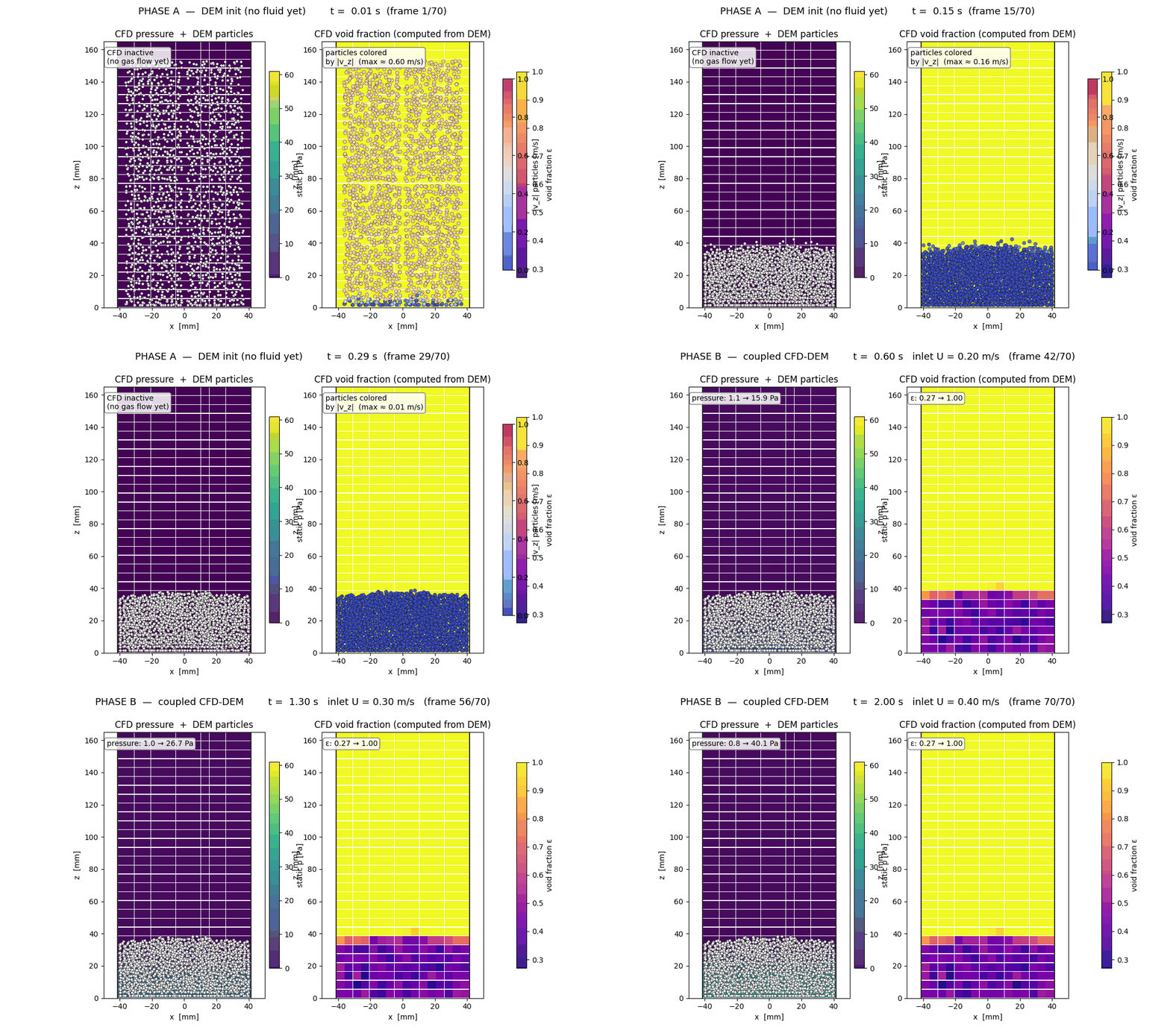 Coupled CFD–DEM
CFD–DEM Fluidized Bed Dynamics
Two-panel visualisation of a coupled Computational Fluid Dynamics & Discrete Element Method (CFD–DEM) simulation of a gas–solid fluidized bed. Left: static gas pressure field overlaid with DEM particle positions. Right: void fraction ε computed from the particle distribution, with particles coloured by vertical velocity magnitude |vz|. Phases A → B → C trace the bed through DEM initialisation, gas injection, and fully fluidized regime.
Dam Break — Free-Surface Flow
High-resolution simulation of a dam-break event using the Volume of Fluid (VOF) method to capture the sharp air–water interface. The water column instantaneously released propagates along a horizontal channel, exhibiting bore formation, wave run-up, and complex splash dynamics. Results validate against classical Ritter and Martin & Moyce analytical benchmarks.
DrivAer Fastback — Vehicle Aerodynamics
External aerodynamics of the DrivAer fastback road-car benchmark at 144 km/h (Re ≈ 1.2 × 10⁷), solved as a transient k–ω SST delayed detached-eddy simulation in OpenFOAM with a moving ground belt and rotating wheels. The centreline slice shows spanwise vorticity — A-pillar and roof shear layers feeding an asymmetric base wake shedding at ~8–9 Hz. Mean drag Cd ≈ 0.31, inside the published DrivAer reference band.
HCCI Engine — Compression Autoignition
A 2D HCCI (homogeneous-charge compression-ignition) run — a lean n-heptane/air charge compressed by a moving piston until it autoignites without a spark. A custom OpenFOAM solver couples detailed chemistry to a moving (ALE) mesh, using a 90-species skeletal mechanism DRGEP-reduced from the 544-species LLNL reference and validated against Cantera to under 1 % on 0-D ignition delay. It captures the two-stage NTC cool-flame then main autoignition at −19.8° ATDC (peak 2293 K, 44.3 bar); the OH radical marks the ignition front.